

Coban isn’t an accidental “failed adhesive” story. Someone engineered that behaviour deliberately. The surprise lies in how many uses the world found for it afterwards.
The finger
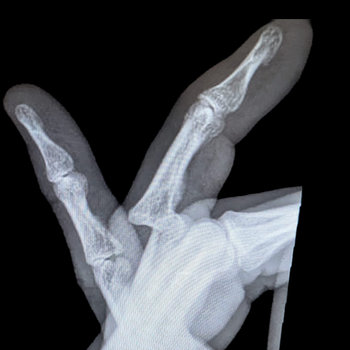
Two weeks ago I dislocated the middle joint of the ring finger on my left hand.
I was running through a forest, caught my foot on a tree root, stumbled forward and drove my hand into the bark of a tree.
I felt nothing. Then I looked down.
My finger pointed in completely the wrong direction.
My running companion drove me to the local hospital. X-rays followed. No fracture, thankfully — just a dislocation, though “just” isn’t the word that springs to mind when one of your fingers has adopted an entirely new geometry. Gas and air took care of the rest, and I felt nothing as the joint went back in. A metal-and-foam splint then held everything still.
“Copin? Copam? Corbin?”
Five days later, the rehabilitation team rang with the recovery protocol: wean off the splint, massage the developing scar tissue, start moving the joint gently, and use something called Coban tape for light support.
At least, that’s what I thought they said.
“Copin?”
“No, Coban.”
“Copam?”
“Coban.”
“Corbin?”
Eventually I asked the caller to spell it. C-O-B-A-N.
I had never heard the word. I had never knowingly seen the product. No chemist or pharmacy near me stocked it, so I ordered a roll online.

Roll of 3M Coban tape
The tape that wasn’t sticky
My first problem was finding the end.
The tape seemed stuck to itself. When I finally unwound it, though, I found no adhesive at all — nothing gummy, nothing that grabbed my skin, my clothes or the fluff in my pocket. It stuck only to itself.
It stretched, too. Wrapped loosely, it gave my finger gentle support. Add tension and it firmed up. It stayed put without clips or knots. It dried out when it got damp. I could strip it off for my home physiotherapy exercises and rewrap in seconds. I could even drop the loose roll in my pocket without it sticking or picking up pocket fluff.
A minor miracle.
So how does it work? How does something hold that securely without feeling sticky? Why had I never come across it? Did someone stumble on it — another Post-it Note story, a failed adhesive that found its purpose by accident? Or did somebody set out to build a material with exactly this combination of properties?
Who invented it? What problem were they chasing? And what have people done with it since?
I went down the rabbit hole. Coban tape has stretch and compressive properties.
A deliberate invention
No lucky mistake. Someone engineered Coban to behave this way: elastic enough to support, porous enough to breathe, conformable enough to follow the body, and cohesive enough to grip itself without grabbing skin or hair.
3M inventor Paul E. Hansen filed the foundational patent in May 1967. It granted in 1971 under the gloriously unromantic title “Elastic shirred web product”. It describes elastic yarns sealed between two very thin nonwoven webs. Let the stretched elastic relax and the surrounding material gathers — “shirrs” — into a light, extensible structure.
The patent names a self-adherent porous elastic bandage as a preferred use. It walks through wrapping a knee or an ankle, applying minimum tension at the ends and much greater tension over the injured section, and producing a wrap that holds under tension, adheres to itself, and strips off without pulling at the patient.
The mechanism was deliberate. The full field of use was not.
The capability arrived before the market
Hansen graduated in chemical engineering in 1954 and started at 3M in St Paul the following week. He landed in the Product Fabrication Lab — an old dairy building, deliberately sited away from the main campus, where Dick Drew gave engineers room to run. 3M had recently acquired a Rando Webber, a machine that formed a particular kind of nonwoven fabric. It fell under Hansen’s control, and his first task was working out what it could do.
That detail matters more than the patent does.
Coban did not begin with a tidy customer brief. It came out of a new manufacturing capability, deep in-house knowledge of adhesives, and a working awareness of what clinicians struggled with.
So the route was not: identify a problem, commission a solution. It was closer to: acquire a capability, explore its behaviours, combine them with what you already know, then find out where the value sits.
Worth asking of your own organisation: what can your platform already do that nobody has written a requirement for yet?
What problem was it solving?
Traditional elastic bandages loosened, and usually needed clips, pins or extra tape. Ordinary adhesive tape stuck painfully to skin and hair, and could damage fragile tissue.
Coban pulled apart two functions that products had always bundled together:
- Compression and support come from the stretched elastic structure.
- Securement comes from one layer cohering to the next — not from adhesive bonding to the patient.
Separate those and the wrap behaves like tape without touching skin like tape. It holds without knots, clips or pins. Change the tension as you wrap, and you change the support.

Coban isn’t sticky and just magically attaches to itself without any glue or pins or tape! It’s a fascinating material.
From product to platform
The patent never limited the technology to one bandage. It describes a covering material in general, and contemplates gloves, caps and bags made from heat-sealed versions of the same web. Hansen appears to have understood he had a platform — even though he could not know where it would end up.
Where it actually ended up
Blood draws and dressing securement. Coban’s most familiar role became applying light pressure after a blood draw or a donation, holding small dressings, and securing devices. These are not the knee-and-ankle examples in the patent, but they follow directly from the same properties: fast application, adjustable pressure, reliable hold, and no adhesive on the puncture site.
Hand therapy and swollen fingers. Occupational and hand therapists took narrow Coban wrap and used it to manage post-surgical and post-traumatic swelling in fingers, hands and wrists. It stays put better than a conventional elastic bandage and allows movement during rehabilitation — which is exactly where I met it, decades on.
Veterinary medicine. The technology moved into animal care through Vetrap. Sticking to itself rather than to fur turned out to matter enormously. 3M later engineered higher-support versions specifically for horses, turning an adjacent use into a deliberate, market-specific product line.
Chronic wounds and lymphoedema. Coban also became part of multilayer compression systems for venous leg ulcers and chronic oedema. The material had travelled from the acute sprain to long-term vascular and lymphatic management.
Getting a trapped ring off. A hand surgeon published a “Coban method” for removing tight rings from swollen fingers: wrap the finger, compress the tissue, then walk the ring over it. It adapts a much older string technique — but it remains a vivid example of exaptation. A supportive bandage becomes part of a procedure nobody at 3M sat down to design.
Everyday improvisation. People also bundle objects with cohesive wrap, improve grips, tidy cables and make temporary repairs. Not approved medical applications — but revealing. Anyone can understand what the material does within seconds of handling it, and start imagining what else it might do.
The product kept moving
Later versions answered requirements that only widespread use could surface: latex-free chemistry, sterile packaging, narrower widths, more predictable compression, and hand-tear construction so clinicians can work without scissors.
Incremental, yes. Trivial, no. Once a technology lands in real workflows, users expose constraints the original design never anticipated. Good products generate their own next brief.
Seven things Coban teaches us about innovation
1. “Deliberate or accidental?” is usually the wrong question. Coban’s defining mechanism was intentional. Its range of applications emerged over decades. Deliberate invention, then distributed discovery.
2. Capability can precede market. A new machine and a body of adhesive expertise existed before anyone had identified every valuable application. Alongside “what problem should we solve?”, try “what new behaviour can this capability create?”
3. Legible affordances invite invention by others. Coban stretches, conforms, compresses, breathes and sticks to itself. Those behaviours are visible. Nobody needs the chemistry to imagine a new use.
4. Lead users are part of your innovation system. Therapists, surgeons, vets and patients were not consuming a finished product. They were developing applications. Do you know who yours are — and are you listening to them?
5. A platform outlasts its first product. The durable asset was never a roll of bandage. It was capability in elastic nonwovens, cohesion, compression and manufacturability, which has supported a growing family of products for over fifty years.
6. Adoption writes the next design brief. Latex sensitivity, infection control, cutting tools, different anatomies: all became visible through use. Innovation looks less like a eureka moment and more like a long conversation between a technology and the world.
7. Generative products still need guardrails. The same elasticity that makes cohesive wrap useful can apply too much pressure, especially around an injured finger. Encourage experimentation, but pair it with clear guidance, testing and attention to safety.
The answer at the bottom of the rabbit hole
Coban is an intentional platform invention followed by distributed application innovation.
3M engineered a material with a distinctive bundle of behaviours. The company built some extensions itself. Clinicians and other users found more. Some of those improvised uses then got formalised, tested, repackaged and turned into specialised products.
That offers a useful correction to the usual mythology of innovation. Not every remarkable product started as an accident. And purposeful design does not mean anyone foresaw every valuable use.
The inventors created the behaviour. The world worked out what the behaviour was for.
So my dislocated finger led somewhere I did not expect. A small roll of strange, non-sticky tape turned out to be a compact demonstration of how innovation really works — through curiosity, recombination, experimentation, observation, and a willingness to let users show you possibilities that were never in the brief.
A safety note
Cohesive wrap can restrict circulation if you apply it too tightly. Follow the guidance of your treating clinical team, and loosen or remove the wrap if you notice increasing pain, numbness, tingling, colour change, coldness or worsening swelling.
Trademarks
Coban, Vetrap, Post-it, 3M, Solventum and Rando-Webber are trademarks of their respective owners. This article is independent commentary, written without affiliation, sponsorship or endorsement from any trademark owner. Product names appear for identification only.
Written by Eddie Pratt, Managing Director at Product Focus
Sources and further reading
- Paul E. Hansen, “Elastic shirred web product”, US Patent 3,575,782 (filed 19 May 1967; granted 20 April 1971), assigned to Minnesota Mining and Manufacturing. Link
- UW–Madison College of Engineering, “Alumnus Paul Hansen’s ingenuity spawned successful 3M products” (2017). Link
- Paul E. Hansen, “High elastic modulus bandage”, US Patent 4,984,584 (granted 1991), assigned to Riker Laboratories, a 3M company — the equine and higher-support development. Link
- Solventum (formerly 3M Health Care), Coban Self-Adherent Wrap product information. Link
- 3M/Solventum Coban NL Non-Latex Self-Adherent Wrap range, including hand-tear and sterile variants. Link
- Tan V. “Coban Method for Removing a Constricting Ring.” Hand (N Y), 2019;14(1):133–134. Link
- Franks P. et al. “Evaluation of the performance of a new compression system in patients with lymphoedema.” International Wound Journal, 2013. Link
- Miller L.K. et al. “Effectiveness of edema management techniques for subacute hand edema: a systematic review.” Journal of Hand Therapy, 2017 — Coban as a current compression option in hand therapy. Link
About Augmented Collaboration: augmentedcollaboration.com
Leave a comment