

The Virgin Media O2 loyalty story, Efani‘s peace-of-mind proposition, Xplora‘s carve-out of the family segment — behind each sits a big strategic commitment. Acquisitions. Brand partnerships. Board-level bets. Build, buy or partner decisions usually live with heads of product and the C-suite.
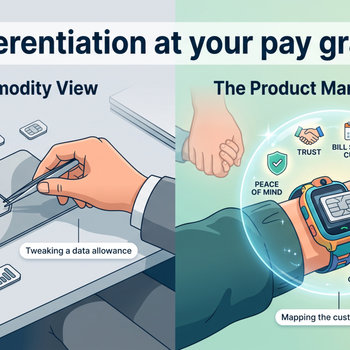
So where does that leave you, the everyday product manager, when you’re asked to “differentiate” or “come up with a unique value proposition”, but the levers are three pay grades up? Tweaking a data allowance to match a competitor’s weekend flash sale can feel like rearranging deck chairs on a commodity ship.
Here’s one reframe: you may not sign the cheque (if you remember those old-fashioned things 😀), but you own the problem space, the evidence and the narrative. That’s more power than it sounds. Four places you could use it.
1. Get your shoes dirty
Differentiation rarely starts in a boardroom. It starts on the pavement.
When I walked into three mobile operator stores on a local high street and asked “do you have phones for children?”, the “no” I got back wasn’t just an anecdote — it was the sound of money being left on the table. Anyone can collect that evidence in less than 15 minutes.
While you’re there, hunt for workarounds. If parents are buying standard SIMs and spending hours locking them down with third-party apps or navigating a barrage of menus, that friction is a product opportunity nobody has claimed. And anchor on evergreen pains: technology changes, but people will always worry about their children and their parents. Those anxieties outlast any network generation.
Then find out where your segment actually congregates. When I asked a friend how they discovered Xplora, the answer wasn’t an operator store, a search ad or a comparison site — it was Smartphone Free Childhood, a community of parents wrestling with exactly this worry. Niche propositions get discovered through the niche’s own channels, not the commodity ones. Mapping those channels costs nothing but curiosity, and no one needs to approve it.
2. Look sideways, not just across the street
When direct competitors are trading blows on price, the useful signals are elsewhere.
Scout other countries — a proposition mature in Germany, the Nordics or Japan may be absent in your market, which means the proof of concept already exists. Borrow from adjacent industries: banks moved from “storing money” to financial wellbeing; airlines sell radically different propositions for the same seat on the same flight. And deconstruct the specialist MVNOs. Work out exactly which features and benefits Efani and Xplora strip away, and which they amplify. The pattern is learnable.
3. Slice the market by worry, not by age bracket
You don’t need permission to segment differently. Drop “adults 18–35” and try “first-time parents anxious about screen time” — segments defined by the job to be done and the worry behind it.
Then run the opposites exercise: take your standard offer and systematically ask “what if we did the reverse?” Instead of unlimited everything, restricted access. Instead of more, less. That single inversion is most of Xplora’s proposition.
And plenty of differentiation already sits inside your remit. Positioning: the same SIM sold as a “first phone starter kit” — safety settings on by default, an onboarding journey written for parents — is a different product without a single network change. Experience: billing so clear that “no bill shock” becomes the differentiator; pausing a child’s data in two taps. Micro-partnerships: acquiring a hardware company is a board decision, but bundling a parental-control app or an educational service into a tariff often isn’t.
4. Make the case impossible to ignore
This is where ground work becomes corporate action. Map your stakeholders and learn what they’re measured on — ARPU, churn, brand consideration — then translate your segment into their language. Frame retention as household lifetime value, the way Virgin Media O2 does.
Then pitch small. Not “we should transform our proposition” but a localised, de-risked pilot: this segment, this size, this cost, this churn effect. You’re not asking leadership to make the build, buy or partner decision. You’re making it impossible for them not to.
The takeaway
The commodity trap isn’t just a market structure — it’s a habit of thinking that starts with “we can’t.” The PMs who escape it are the ones closest to the ground, who turn what they see there into a case the business can’t unsee.
So, over to you — what’s the best differentiation you’ve shipped from inside your own remit, without a board decision in sight? Share it below; the small wins are the ones this series is really about.
P.S. If you’re ready to build that case, here are two places to start: the Product Focus – Business Cases journal and the Product Focus – Market Analysis journal.
Leave a comment